

The proceeding concerns the complaint about Benita’s June 2023 flyer. Allegations are not findings.
Sourced chronology
Two timelines. One public debate.
The complaint about Benita’s flyer and Westlock’s later municipal petition-and-vote process share subject matter. They are related public context, but they are legally separate.
Important distinctionThe Tribunal proceeding concerns the complaint about the flyer. The Town’s petition, plebiscite and bylaw were a separate municipal process and are included as “Did you know?” background.
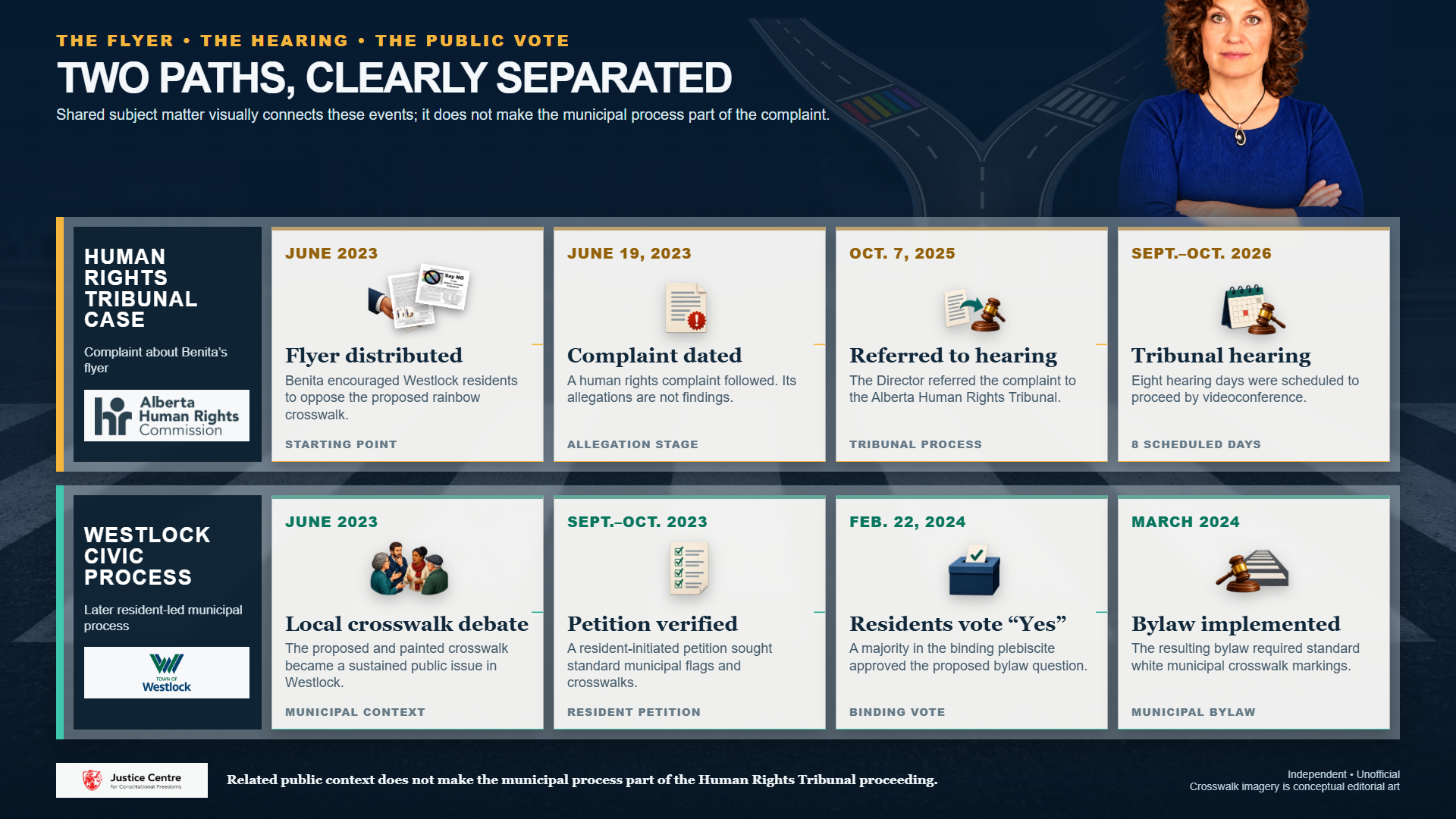
Westlock’s later resident-led process concerned related subject matter but was legally separate.
Detailed source notes
What happened, and when
Dates below are drawn from official public records, the redacted complaint, municipal releases and attributed reports from the parties or media. Where sources conflict, the conflict is shown.
Flyer circulation begins
The publicly posted redacted complaint identifies June 6. The provenance supplied with the flyer images identifies June 7. The exact first circulation date remains to be reconciled.
Public organizing and council participation
User-supplied Facebook references document a parking-lot rally and promotional material encouraging attendance at a Westlock council meeting. These links are retained as leads and require archival verification.
Crosswalk painting date identified in the flyer
The flyer describes the planned painting date as Father’s Day, June 18. This is evidence of what the flyer said, not independent proof of the municipal project timeline.
Human rights complaint dated
The publicly posted complaint alleges discrimination in statements and publications. It asks for a retraction or acknowledgement of harm and an apology. Those are the complainant’s allegations and requested resolution, not Tribunal findings.
Resident petition is submitted and verified
The Town of Westlock says a resident-initiated petition was submitted at the end of September, verified on October 30 and publicly announced November 7. Council later referred the proposed bylaw to a binding plebiscite.
Westlock voters approve the bylaw question
The Town reported that residents voted in favour of restricting municipal flagpoles to government flags and requiring municipal crosswalks to use a standard white pattern.
Council passes the Crosswalk and Flagpole Bylaw
Local reporting says Council unanimously passed second and third readings following the binding vote. Later reporting describes the rainbow crosswalk as painted over to comply. This municipal implementation was separate from the Human Rights Tribunal complaint.
Complaint referred to a hearing
The Justice Centre for Constitutional Freedoms reports that the Director referred the matter to the Tribunal to consider section 3 of the Alberta Human Rights Act. Referral is not a final decision on the merits.
Defence and media coverage becomes public
JCCF announced that its funded lawyers were assisting Benita Pedersen. Multiple later articles relied substantially on that release; the source library identifies these dependencies.
Witness-exclusion motion reportedly denied
A September JCCF update says the Tribunal denied a Director’s motion to exclude most proposed defence witnesses. A primary Tribunal ruling has not yet been located in this project’s public-source review.
Eight hearing days scheduled
The official schedule lists September 14–18, September 28–29 and October 2 by videoconference.
Check for a written decision
The Alberta Human Rights Commission decisions collection on CanLII is the official publication point to check for any later written finding.